
The job profile
Most kerb demolition is concrete somewhere between 100 and 300 mm thick, often with light reinforcement and a sub-base that varies between rolled gravel, cement-stabilised sand and compacted limestone. The work is linear: long lengths at consistent thickness, with the constraint that the road, pavement, driveway or grass adjacent to the kerb is usually not part of the demolition scope.
Carrier and breaker selection
- Skid steer with breaker (SD8 to SD12): tight residential streets, narrow driveways. Best where you also need to load spoil.
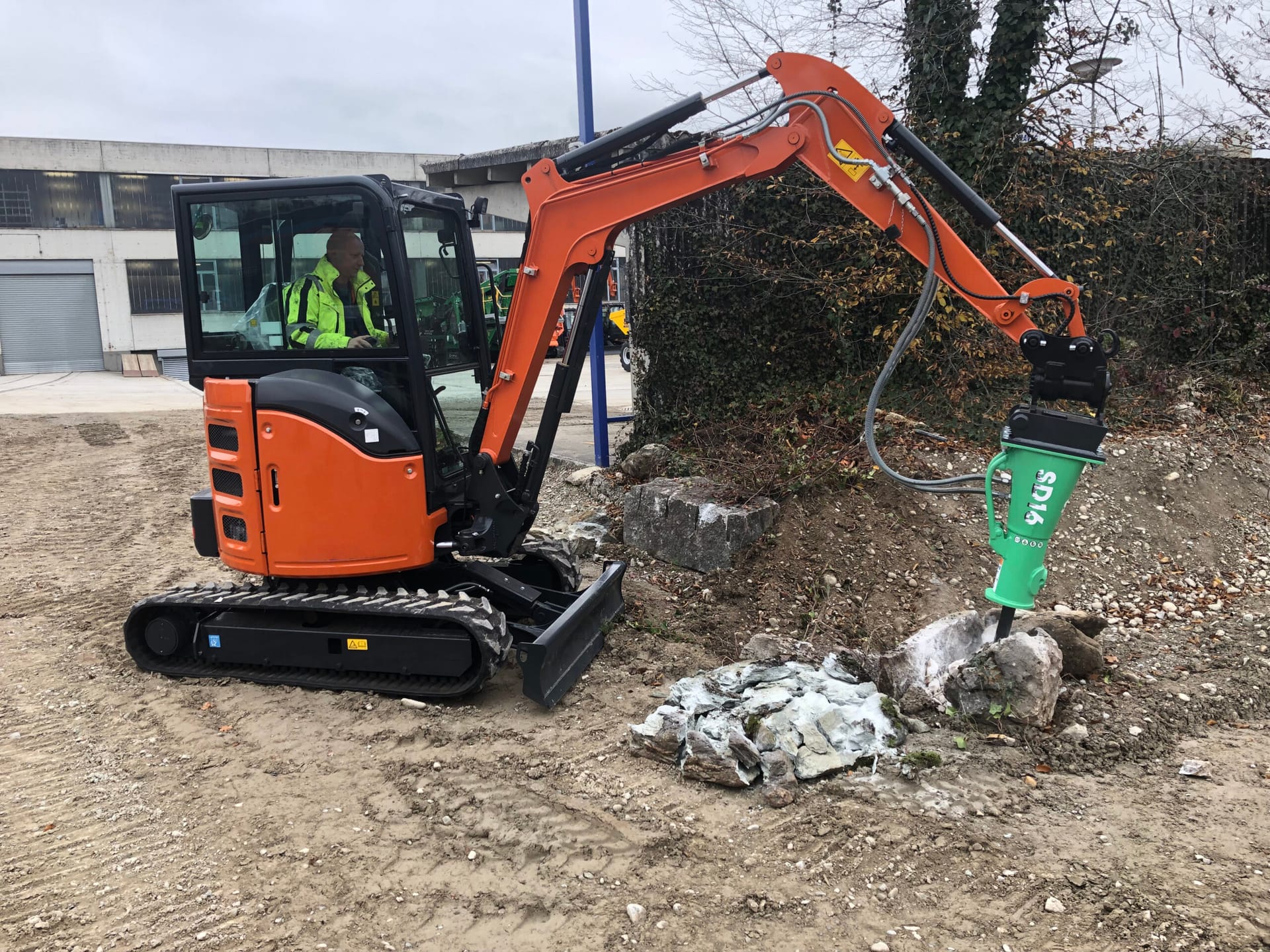
- 3 to 5 tonne excavator with SD16: the standard urban kerb crew. Punches through 200 to 250 mm reinforced kerb cleanly.
- 5 to 8 tonne excavator with SD22 or SD28: heavier kerb-and-channel, heavily reinforced civic kerbs, traffic island removal.
Technique for edge work
- Score the line first. A few starting strikes along the line you want to break creates a fracture path. The next pass propagates the crack rather than punching random holes.
- Hold the chisel parallel to the road, not perpendicular. A 90-degree attack drives chips outward. A parallel attack drives them along the kerb line where you want them.
- Work in 1 to 2 metre sections. Break a section, clear, repeat. Long unbroken runs let chips bounce into adjacent surfaces.
- Switch to a narrow chisel for the final separation. A moil over-breaks and risks damaging the adjacent slab.
Safety and adjacent damage
- Adjacent surface protection: a sheet of plywood and rubber matting on the road side of the kerb absorbs chip impacts. Cheap insurance against damaged asphalt.
- Pedestrian exclusion: chips travel further than expected on hard kerb. Maintain a 5 metre exclusion zone behind the breaker.
- Underground services: water, gas and electrical commonly run within 300 mm of the kerb in Australian streets. Always work to a current Dial Before You Dig plan and pothole before deep work.
- Operator vibration: long sessions of kerb work transfer significant vibration through the carrier. Plan operator rotation.
For kerb crews running multiple breakers in a fleet, our scheduled maintenance program keeps tool wear and tie-rod failures off the critical path. Talk to us about a fleet contract.