
The constraints urban demo lives with
- Noise: hydraulic breakers are the loudest tool on a demolition site. Local authority limits and resident tolerance often dictate breaker hours.
- Dust: EPA and local council rules around airborne particulates can stop work entirely. Cutters and pulverisers manage dust differently to breakers.
- Vibration: adjacent buildings, retained heritage facades and underground rail tunnels all set vibration limits. Shears and pulverisers transfer less shock than breakers.
- Access: CBD and inner-suburban sites often have a 1.5 to 2 metre crane envelope. Attachments stack up the carrier weight that has to come in through that envelope.
Stage-by-stage attachment selection
Stage 1: Soft strip and internals
Sorting grabs and demolition grabs (Rotar RG and RPG series) are the right tools for clearing internals, fitouts and non-structural elements. They move material into skips without breaking it, which keeps dust and noise low.
Stage 2: Primary structural reduction
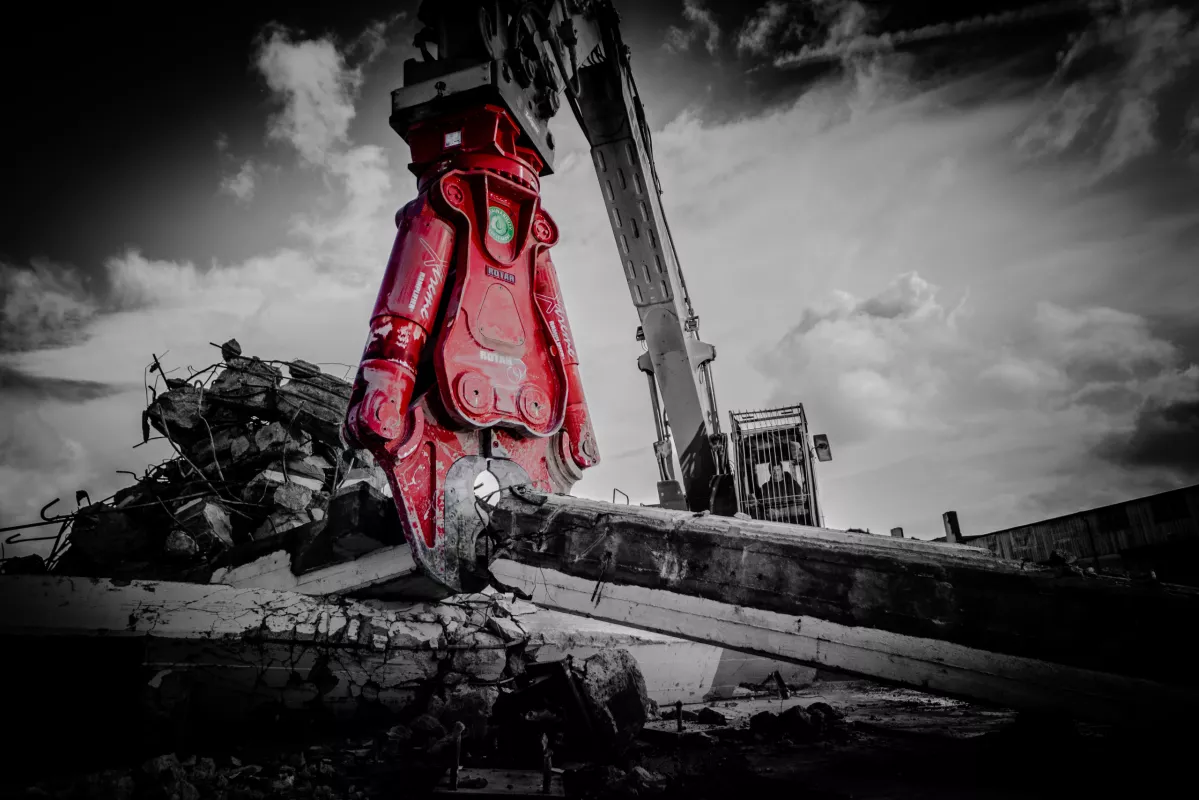
For reinforced concrete primary work in noise-sensitive locations, a combi shear (Rotar RDC) or pulveriser (Rotar RDP) is the right choice. They cut steel and crush concrete with a fraction of the noise and vibration of a breaker.
For steel-frame structures, a scrap shear (Rotar RSS) cuts beams and columns cleanly, sorts steel for recycling and produces the lowest noise signature of any structural attachment.
Stage 3: Concrete processing and recycling
Static pulverisers (Rotar RSP) run on the ground crushing the larger demolished material into reinforcement-free fragments suitable for crushing and recycling. They process material the primary attachment couldn't get into a small enough size.
Concrete cutters (Rotar RCC) handle the awkward in-between work: heavily reinforced sections that a pulveriser can't crush and a shear can't separate.
Stage 4: Slab and footing breakout
This is where breakers come back in. A hydraulic breaker on a 20 to 25 tonne carrier breaks slabs, footings and the last ground-level concrete. Schedule this work for noise windows when adjacent occupants will tolerate it, and use the variable-frequency Montabert V Series so you're not running at full impact when the material is already fractured.
Noise and dust management
- Cutters and pulverisers run 5 to 10 dB(A) below comparable breakers. On a 65 dB residential limit at the boundary, that's the difference between operating and being shut down.
- Water suppression on cutters and shears is more effective than on breakers because the cutting action exposes new surface continuously rather than fracturing existing surfaces explosively.
- For monitored sites with vibration sensors, switch from breaker to pulveriser when the structural element is reducible. The vibration delta is significant.
Selecting the right attachment fleet
For a typical inner-suburban demolition contractor running two 22 tonne carriers, the attachment shortlist looks like this:
- One demolition grab (Rotar RG) for soft strip
- One combi shear (Rotar RDC) for steel and primary concrete
- One demolition pulveriser (Rotar RDP) for reinforced concrete reduction
- One Montabert V1800 or V2500 breaker for slab and footing breakout
- OilQuick couplers on both carriers so attachments swap in seconds
The OilQuick couplers in particular are what make this fleet work. Without them, a crew will commit to one attachment per shift and miss the productivity gains the others unlock. With them, the operator changes attachment as the work changes.
For demolition fleet planning advice, contact our Malaga workshop. We've helped multiple WA contractors size attachment fleets for major inner-suburban projects.