
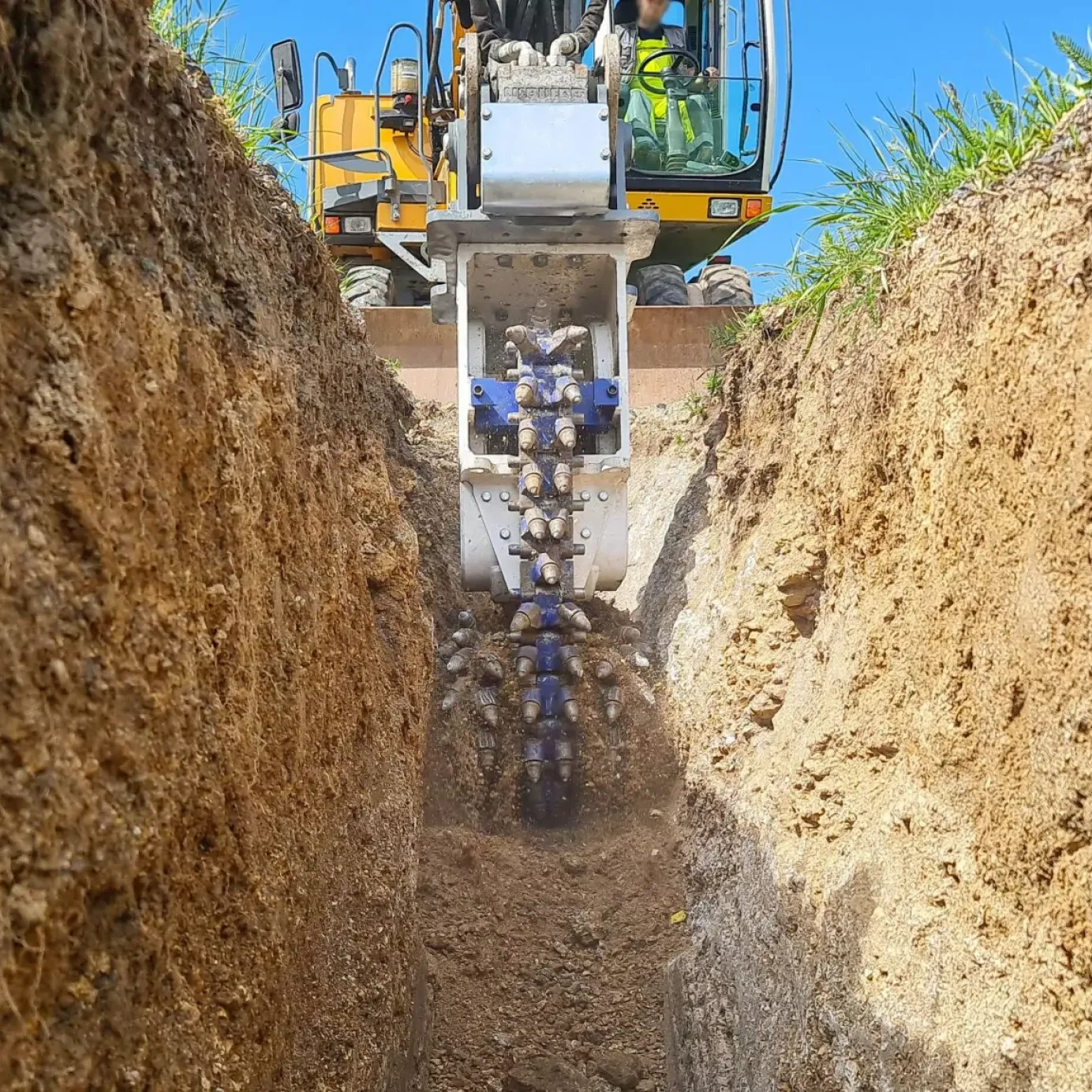
Why fibre trenching is harder than it looks
Utility trenches need to be narrow (300 to 600 mm typical) and consistent in depth and wall finish. A standard bucket cuts a 600 mm trench but produces a sloppy edge that costs you in spoil management and reinstatement. A breaker can punch through rock but produces a wide, irregular trench. A trencher cuts a clean line but can't handle reinforced sections.
Most Australian fibre and gas utility runs cross all three conditions on a single kilometre of trench: soft soil, hard rock caps, and the occasional reinforced concrete crossing.
Three tools to choose between
- Hydraulic breaker: right tool only when rock is dense and short sections need to be broken before excavation. Slow per-metre on continuous trench.
- Chain trencher: production-rate trenching in soil and weak rock. Excellent in fractured material, struggles in dense unfractured rock and reinforced concrete.
- Chain cutter (rock saw): the right tool for rock and reinforced concrete trenching. Cuts a clean kerf at consistent depth, leaves vertical walls, and handles rebar with the right teeth fitted.
Why Kemroc chain cutters dominate this work
For trenching through rock, the Kemroc EK chain cutter is the most productive tool we sell. It mounts on the excavator like a bucket, cuts a 200 to 400 mm wide trench at depths up to 2.5 metres in a single pass, and runs from the carrier's auxiliary hydraulics without needing a high-flow upgrade.
Compared to a breaker on the same trench, an EK chain cutter typically delivers 3 to 4 times the metres per day. Compared to a chain trencher, it handles harder material at similar production rates. The economic case is strongest on jobs longer than 200 metres of rock trenching.
Application notes
- Carrier sizing: EK40 mounts on 5 to 13 tonne carriers. EK80 to EK100 mount on 13 to 25 tonne carriers. EK150 and above for 25 tonne plus.
- Hydraulic flow: consult the data sheet for each model; most modern excavators have enough auxiliary flow once the high-flow line is fitted.
- Tooth selection: conical teeth for rock, picks for concrete, stronger tungsten-carbide grades for abrasive iron-ore-bearing material.
- Dust: chain cutters generate fine rock dust. Plan water suppression for residential and urban work; brief site teams on respiratory PPE.
- Rebar: the EK can cut light rebar with the right teeth. For heavy rebar (over 25 mm), pre-cut with a saw or shear before running the chain cutter.
For project-specific advice on sizing an EK to your excavator and your typical material, contact our Malaga workshop. We hold demonstration units for in-field assessment on larger jobs.