
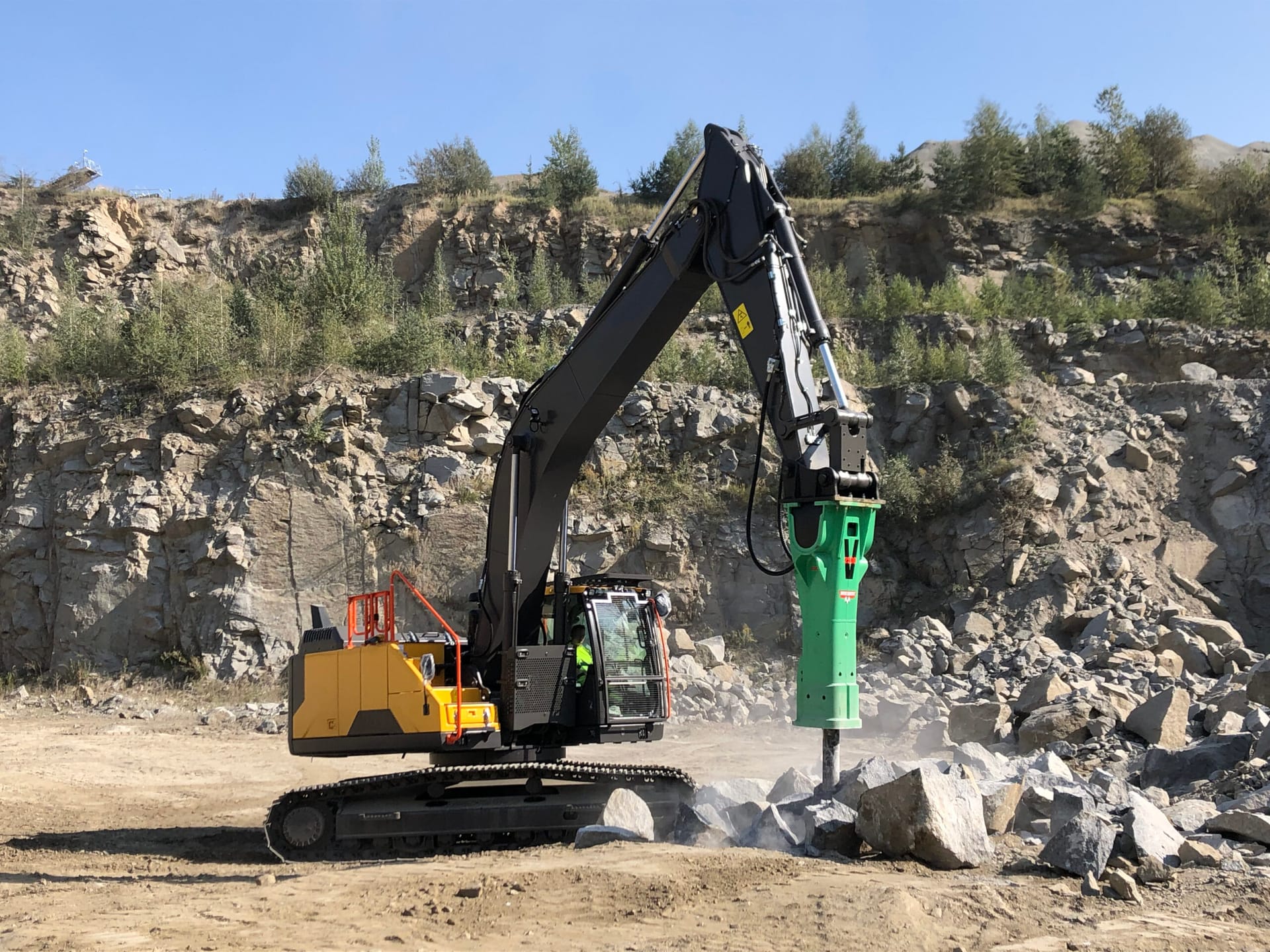
Why sizing matters
A hydraulic rock breaker is a coupled system: the carrier supplies oil, the breaker converts that oil flow into impact energy, and the tool transfers that energy into the rock. Get any one of those three out of balance and the whole system suffers.
- Undersized breaker on a big carrier: excessive flow forces the breaker to over-cycle. Seals fail early, accumulator pressure drops, and impact energy per blow actually decreases.
- Oversized breaker on a small carrier: the carrier struggles to hold the breaker against the rock. Operators lift the boom into recoil, which destroys mounting bushes and tie rods within months.
- Right-sized breaker, wrong tool: a moil point in granite blunts in hours. A blunt in concrete glances and welds slag onto the bushings.
Sizing isn't about a heavier breaker being a better breaker. It's about matching the impact-energy-per-blow and the blows-per-minute to both the carrier hydraulics and the material you're breaking.
The five numbers on a breaker spec sheet
Every reputable breaker manufacturer publishes the same five numbers. Here is how to read them.
1. Operating weight (kg)
The breaker's own mass, including the housing and standard tool. As a rule of thumb, operating weight should be between 8 and 12 percent of the carrier's working weight. Light compact breakers can run lower; heavy primary breakers run higher.
2. Carrier weight range (tonnes)
Manufacturers state a minimum and maximum. Stay inside the range. If your carrier sits right at the edge, step a model size in the safer direction: undersize for stability work like trenching, oversize for primary breaking on hard ground.
3. Oil flow range (litres per minute)
Cross-check this against your carrier's auxiliary circuit on the data plate. Too little flow and the breaker won't reach rated frequency. Too much flow and the over-stroke dampener takes the load, shortening seal life. Most modern Montabert breakers have a wider flow window than older Korean-built units, but you still want to land in the middle third.
4. Working pressure (bar)
The maximum pressure the breaker is rated for in continuous operation. The carrier's relief valve must sit above this number. If you're retrofitting a breaker to a carrier that came from another job, get the relief verified by an authorised hydraulics technician before commissioning. We see relief valves miscalibrated more often than any other sizing fault in the field.
5. Striking frequency (blows per minute)
Higher BPM is better for soft and fractured material. Lower BPM with higher impact-energy-per-blow is better for dense rock and reinforced concrete. Variable-frequency breakers like the Montabert XL range adjust automatically based on resistance, which is why they tend to dominate quarry primary work.
Carrier-class quick reference
A starting-point table for matching a Montabert breaker to a typical carrier weight. This is a guide, not a rule. Always confirm with your hydraulics specialist or our team.
| Carrier weight | Indicative breaker class | Montabert models in this range |
|---|---|---|
| 0.7 to 3 tonnes | Mini-class compact | SD6, SD8, SD12 |
| 3 to 5 tonnes | Compact | SD12, SD16 |
| 5 to 8 tonnes | Compact / small medium | SD22, SD28 |
| 8 to 14 tonnes | Medium | SD36, SD42, V32, M900 |
| 14 to 25 tonnes | Medium / heavy | V45, V55, V65, V1800 |
| 25 to 45 tonnes | Heavy | V2500, V3500, V4500 |
| 45 tonnes and above | XL / primary breaking | V6000, V7000, XL1000 to XL2600 |
Tool selection: moil, chisel or blunt
The wrong tool will out-fail every other component on a breaker, and tools are the cheapest line item you'll replace. Choose deliberately.
- Moil point: rock and reinforced concrete primary breaking. Concentrates impact into a single point, fractures dense material. Wears fast in abrasive rock.
- Narrow chisel: trenching, line cracking, separating slabs along a predetermined plane. Less penetration than a moil but better for control.
- Wide chisel: asphalt and softer material breaking, edge work, finishing.
- Blunt: reinforced concrete with heavy rebar. Energy spreads across a flat face, shatters the matrix without bouncing off the steel. Not for rock.
Five common sizing mistakes we see in WA
- Sizing on bucket pin compatibility, not hydraulics. The pin will fit a lot of breakers. The hydraulics will only run a few of them properly.
- Reading the wrong number on the carrier data plate. Auxiliary flow is not the same as main pump flow. Look for the breaker circuit specifically.
- Ignoring back pressure. Long hose runs and undersized return lines push back pressure above the breaker's tolerance. The breaker still cycles, but at half the rated impact energy.
- Running the wrong tool for the material. A moil in clean granite is fine. A moil in concrete with rebar is a one-week tool.
- Skipping the lubrication schedule. Auto-lube failure accounts for most premature bushing wear we see. If the system isn't fitted, the operator must grease every two hours of breaker time, not every shift.
Next steps
Pick the carrier-class guide that matches your machine to see specific model recommendations, typical applications, and the sizing trade-offs in that range. Or, send us the carrier make, model, year and your typical material, and we'll send back a sized recommendation the same day.